
Spotlight Series: The Prepared Piano | Lukáš Janata
Hello and welcome to the final preview for our upcoming show, Spotlight Series: The Prepared Piano coming up NEXT SUNDAY!! For this week, we got a chance to interview one of the composers, Lukáš Janata.

Janata, Tin Yi Chelsea, and Leah overlapped in conservatory thus bringing this collaboration into existence! Since graduating from the conservatory, Janata has been commissioned by the San Francisco Symphony, Orchestra of St. Luke’s, Alarm Will Sound, Cantori New York, Friction Quartet, and the Janáček Philharmonic Ostrava. He is now a doctoral researcher at the University of California, Santa Cruz, where he investigates how creativity activates empathetic mechanisms in the brain. He teaches at The Walden School and the San Francisco Conservatory of Music Pre-College, where he also directs the Collegium chorus.
How would you describe your compositional style? Inspirations? Is there anything specific that drew you to the sonic world of extended technique?
My composition process has always been evolving—in fact, that is how I understand myself as an artist. It's a never-ending process: once it stops evolving, I ask, where is the curiosity, where is the playfulness? Then I need to move away and make space for the ever-curious!
Recently, my work has evolved in the realm of process. Not necessarily through the lens of strict compositional process techniques, but by understanding music as a process that transcends the framework of viewing a piece of music as a static artefact. The process, which I like to call a magical triangle, is integral to the perception, production, and reception of any aesthetic artefact, and understanding that every participant has as much agency as the creator is a powerful concept that I still keep unraveling—
As a doctoral researcher at UC Santa Cruz, I ask questions about how creativity can inspire empathetic mechanisms in the brain through the lens of music cognition. As a board member of the Bay-Area nonprofit The Resonance Project, we investigate music's role in conflict mediation designs. My research in recent years led me to re-frame my understanding of what it means to compose, and how humans—as the only species—naturally have the unique tendency (and need) for musical connection, affect, entrainment, and synchrony.

To give a closer idea when it comes to my specific frameworks of inspiration and background: I grew up singing in a children's choir, playing in progressive metal and swing orchestras, and playing funk and jazz while studying within the Brahms/Dvořák-heritage school of thought at the Prague Conservatoire. I realized that it is only natural—in light of my earlier-mentioned conviction to evolve and grow—to seek guidance and sources of inspiration very much away from any comfort zone, away from home.
I keep getting asked about composers I like, and while this is an extremely difficult question for me, time over time these are a few influential creative figures in my life just within the Western musical tradition: spanning from the beautiful Byzantine chants of Kassia, Dufay's clausulas, Ockeghem's and Gesualdo's imagination and emotion through harmonic propelling and spatialization, J.S. Bach's and J.D. Zelenka's sense of affect through architecture and contrapuntal motion, Beethoven's late chamber works, and the shift to the early Romantic era expressed through Lieder from multiple composers, including R. Schumann.
I enjoy the evolving narratives and principles being attested through practice and pushed beyond their common-practice limitations through many individual works of Romantic composers rather than focusing on one composer solely. Fin de siècle is particularly interesting as it verges and opens up so much excitement and ways of making music in new ways. L. Janáček's music is certainly one of my heart's favorites, and so is the limited but beautiful catalogue of L. Boulanger. From H. Dutilleux, O. Messiaen, to G. Ligeti and D. Shostakovich—20th century music expands on much more, reflecting both the practices of the past and bringing fresh perspectives to the table—hence, fresh musical affect and ways to relate: as a listener, as an interpreter, and as a creator. Late 20th century to contemporary has too many names to list, and it is exciting to see many prominent female figures emerge from the systematically buried access of the past: S. Gubaidulina, K. Saariaho, P. Oliveros, and many, many more.
So this is a very brief set of influences. Clearly, this is not a party question for me, but a deep reflection of political listening: what we culturally constitute as listening access, how we engage with music, and how and to what extent it influences us, whether consciously or subconsciously.
I turn to extended techniques when the established ones don't suffice in pursuit of the artistic affect I wish to express. Sometimes they become the basis because of the modality of my conceptual narrative, and sometimes they don't even remotely touch this sonic world. It really depends.
Were there any special processes you went through to produce Echi___? Is there a distinct or memorable process you went through to create any of your other pieces?
Echi___, as the title suggests, is about echoes in a broad sense. I was looking up my ancient horrible program note in light of writing about this; it was overly analytical and lacked the sense of wonder and vulnerability, which are quintessential elements characterizing this piece. When writing Echi___, I was fascinated by the process of exploring various acoustic effects at the piano that have to do with resonance / echoes and contextualizing these processes into a cohesive musical whole. The result is a vulnerable exploration that is bold, quirky, strange, serious, and aesthetically living on the edges of many sound worlds while maintaining its identity and my language, which is informed by Chelsea's idiosyncratic way of engaging with the piano. She inspired my thoughts with her invention of a piano harmonic capo, as well as her openness and fascination with expanding piano repertoire and exploring it through unexplored sonic synthesis.

As for my processes, they widely vary—sometimes I sketch the entire energy map as if it's an architectural plan, using X and Y planes that inform how I treat proportionality, and how I not lose the forest for the trees, so to speak. Sometimes I flesh my music out completely intuitively, chronologically from the first note to the double bar line. Sometimes it's a big puzzle piece, starting with main processes, ideas, or concepts, or starting from a complete improvisation at the piano. Sometimes, on the other hand, I need to walk away from the piano to be generative. Medium matters a lot—each has distinct sets of challenges and affordances, and even that does not standardize the process.
The most frustrating piece in all this is that I often feel that I can generate "something," and given my educational background, focusing on compositional craft, I have the ability to do that. But most of the time I choose not to go in this direction, as it often disengages me from my devotion to the idea—I feel I go on autopilot. As a result, my processes are often a compositional turmoil—fighting time, instincts (while listening to them), and continuing to explore and be vulnerable while doing so...It's beautiful.
Echi___ is dedicated to our dear friend, Tin Yi Chelsea Wong. A lot of your other chamber and solo music is also dedicated to your friends and colleagues— could you speak a bit about the collaborative relationship between composers and performers?
You are spot on—chamber works are by definition a collaborative process for me. As much as I love the medium of an orchestra and other giant collectives, these environments are rarely personal. Oftentimes your presence and care are very limited within the mechanisms of a fast-paced, often subscription-series-based means of production. On the contrary, commissioning chamber ensembles and individuals often put this struggle aside, allowing (and encouraging) a deep interpersonal connection between the composer and performer.
This is a space where I love to do my research: from understanding my collaborators deeply to understanding concepts I want to explore with them, celebrating their idiosyncratic art-making and challenging their views, approaches, and experiences, and pushing them to new ways of thinking—just as much as I do this to myself along the process!
It is one of my happiest—albeit sometimes scariest—ways of being a composer. The vulnerability, the passion, and the enthusiasm of back-and-forth conversations, refining ideas and realizations, leading up to a thoughtful presentation of the result (that inevitably keeps and will keep changing), are so integral to me and my understanding of what it means to be an arts citizen, new music advocate, and culture sector supporter and contributor.
The collaborations stem from various sources of inspiration: the one with Chelsea arose from our immediate personal and artistic connection, full of passion and dedication, as we found each other in the SFCM community during our graduate studies in 2017.
What is it like to see a piece you’ve composed change (or not) through time as you and the performer grow?
Oh I'm thrilled! I am sure that I will hear it with different ears, just as Chelsea will play it with different hands, revisit the score with different eyes, and interpret it with a different mind. One of the most beautiful things about music is that it is an interdependent listening process rather than a static aesthetic artefact.
Think of a two-way street: one piece will never be performed the same way twice in a row, just as it will never be perceived in the same way either. It is mentally and bio physiologically impossible.
The way we listen / interpret / compose is extremely contingent on our day-to-day lived experience, which informs our directed-ness of listening (e.g.: the first time around in a live performance you're surprised—you focus on the tuba part that came unexpectedly; the second time around you anticipate the tuba part, and even though you've had a long day at work, that tuba part somehow reinvigorates you; the third time around you criticize the tuba part that you've always loved because the player hasn't warmed up appropriately; the fourth time around the tuba entrance has been missed and you're left in absolute shock, affecting your experience).
But even if you wish to argue that you can just audiate the score: your reading and audiating ability is different at different times of the day—your level of exhaustion and alertness, or simply receiving a message alert or a pop-up news notification that someone is waging war somewhere.
My point is that there is absolutely no way to determine any universality or static-ness of a work, its listening, and by no means its performance. Even the codified experience of a recording is listened to differently every time.
And the same goes for my music: whenever there is a new performance, I am excited to see how different it is. In fact, many of my—especially recent—projects are intentionally conceived with this variability in mind.
You’ve spent a lot of compositional residencies in disparate environments from large cities to deserts to lush north eastern forests— how does your environment influence your work? Do you prefer to live in super active and social areas or in isolation with nature?
One life-long major influence was finding a like-minded spirit (and a wonderful musical storyteller) and a partner through one of these experiential visitations—hard to top that:)
However, beyond that, these experiences have been foundational to revisiting who I am as an artist and why, at all, I create and what I try to say. While super active metropolitan hubs are necessary for sustainably thriving and diverse ways of art-making, they can also become an overwhelming mechanism of a capitalist-driven wheel of production.
Some artists may thrive in such an environment without any visible exhaustion, depending on their connection to their art-making. However, for me, and for many of my artist friends who are in a constant dialectic conversation with their minds—revisiting the fundamentals with each new project, seeking (for them) unexplored ways of expression—the production-wheel mechanism can be stifling, and hence there are many organizations across the world offering artists a space for reflection.
I am grateful for these foundations, as I have been fortunate to experience a massive shift in creative thinking resulting in growth as a human being and arts citizen as well. Connecting with local remote communities, focusing on meaningful presence while having the headspace to revisit the most painstaking questions challenging my own thought processes—these are not things and processes I would have been able to make space for within a bustling environment where I would go from project to project and work to work to sustain myself as a freelance artist.
To answer the question, however, my experience is that I cannot live without a metropolitan environment just as much as I cannot live without a remote, tranquil headspace, regardless of its geographical location. And yes, my thought processes and creative ideas are massively influenced by its cultural location, landscape, local communities, and fellow artist-cohort—which I also believe is the point of these residencies.
What pieces do you consider complimentary or related to your œuvre?
Psst. I made an unpublished, simple portfolio website that I'm happy to share with the curious Insight Chamber Players audiences—it contains scores for view (!!). Take a listen at portfolio.lukasjanata.cz (funnily enough, it is more updated than my own website…).
But to answer a little more specifically and in an informed manner: pieces that I consider integral to who I am are pieces that push me in directions that I have yet to explore while being versed in rhetoric that I feel some command over. That balance—competence in my expression, awareness of the possible affect and impact of my music, and complete insecurity about the outcome—is central to my process.
My compositions that combine technical and expressive skill with vulnerability and clarity of struggle are the ones I see as aspirational. And this is true with my connection to other creators; oftentimes a combination of technical command helps me comprehend the narrative arc of one's expression, but it is the individuated vulnerability through whichever means (compositional, rhetorical, affective exploration) that puts the 1+1 together for me and leaves me moved after experiencing such work.
Do you have any favorite SF/Bay Area spots you always hit up when you’re in town? :-)
I wish I could! Oftentimes, I go up to San Francisco for work or projects and then rush back to Santa Cruz. However, up in the Bay, two of my numerous favorites have become Mori Point and San Bruno Park—the views are priceless.
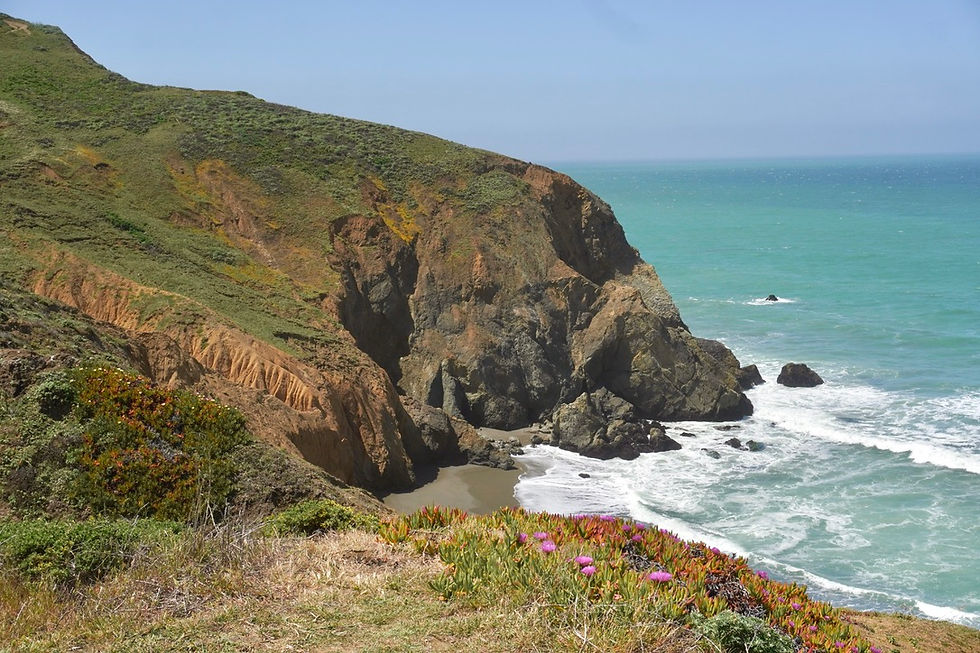
These days, my favorite is the coastal gorgeousness of the Nor-Cal Pacific coast. I like to say—coming from a landlocked country, living—along with my partner—one block from the beach still feels uncanny and is an every-day blessing.
That wraps up our interview! To hear more from Lukáš Janata, come to our concert Sunday, March 22nd where his piece, Echi___ will be showcased! In addition, we invite you to talk directly with Tin Yi Chelsea Wong and Janata during the intermission and after the show to get to know them. See you soon!
Comments